Thursday, July 24, 2008


Tuesday, July 22, 2008
All the "News" That's Fit to Print (Underline News)
A apologize dear readers for having been away from the dance for a while. I must admit that the long primary season wore me out and I honestly don’t think anything of lasting substance is happening right now. I will say that Senator Obama’s world tour on the good ship lollipop must scare the wits out of the GOP. Nothing better than a youthful and energetic Obama traveling around the world, being welcomed like Patton in
A mini-flap arose yesterday when the Drudge Report announced that Senator McCain’s Iraq Op-Ed reply was rejected by the New York Times. This has given the vast right-wing idiocracy an opportunity to thump their chests like the modern day cavemen that they are and scream liberal bias. Liberal bias, liberal bias; the New York Times rejected the Op-Ed because they want Obama to win (like they don’t sell a whole slew of newspapers printing Maureen Dowd’s rants against Republican hypocrisy).
Could there be any other reason? The Op-Ed editor of the New York Times, David Shipley, stated that he would like to publish a piece from McCain but the draft submitted simply did not warrant publishing. He said that he would welcome another draft in the same format as Obama’s (i.e. outlining a plan going forward and defining what victory would look like). The McCain campaign took this as a rejection not of the writing and editing of the piece, but of the Senator’s position. I decided to do a little background research. I read the two pieces so I could judge for myself if one was worthy of publishing and the other not.
It will come as no shock to anyone that Shipley is right. Obama’s piece was newsworthy. He published ahead of a major speech on
Senator McCain’s read more like a review of all the things he was right about (the surge) and all the things Obama was wrong about (everything, after reading the pieces I think Obama might have been responsible for the Lindbergh baby abduction).
Here are the problems with the McCain response:
- It is a response, not a outlining of new policy
- It is loaded with political antagonism.
- It is really badly written (couldn’t find a writer that is smarter than a fifth grader, John?
The New York Times doesn’t exist to provide Presidential candidates with a tit-for-tat forum. They are in the business of printing All the News That’s Fit to Print. The McCain Op-Ed couldn’t reach the bar for that. Pretty sad considering the fact that Britney Spears smoking in front of her children qualifies in this day and age. They must have tripped over the bar. John McCain expected the newspaper of record to publish a piece which is not at all forward looking and simply attempts to trumpet the genius of John McCain. That isn’t even worthy of the Arizona Daily Star, get a blog for that bro!
I won’t pull a FoxNews and draw conclusions for you without providing substance to back it up. Here are the two pieces so you can do your own careful analysis.
Barack Obama’s Op-Ed on
My Plan for
The differences on
In the 18 months since President Bush announced the surge, our troops have performed heroically in bringing down the level of violence. New tactics have protected the Iraqi population, and the Sunni tribes have rejected Al Qaeda — greatly weakening its effectiveness.
But the same factors that led me to oppose the surge still hold true. The strain on our military has grown, the situation in
The good news is that
Only by redeploying our troops can we press the Iraqis to reach comprehensive political accommodation and achieve a successful transition to Iraqis’ taking responsibility for the security and stability of their country. Instead of seizing the moment and encouraging Iraqis to step up, the Bush administration and Senator McCain are refusing to embrace this transition — despite their previous commitments to respect the will of Iraq’s sovereign government. They call any timetable for the removal of American troops “surrender,” even though we would be turning
But this is not a strategy for success — it is a strategy for staying that runs contrary to the will of the Iraqi people, the American people and the security interests of the
As I’ve said many times, we must be as careful getting out of
In carrying out this strategy, we would inevitably need to make tactical adjustments. As I have often said, I would consult with commanders on the ground and the Iraqi government to ensure that our troops were redeployed safely, and our interests protected. We would move them from secure areas first and volatile areas later. We would pursue a diplomatic offensive with every nation in the region on behalf of
Ending the war is essential to meeting our broader strategic goals, starting in
As president, I would pursue a new strategy, and begin by providing at least two additional combat brigades to support our effort in
In this campaign, there are honest differences over
It’s not going to work this time. It’s time to end this war.
John McCain’s rejected Op-Ed to the New York Times (as reported in the Drudge Report)
In January 2007, when General David Petraeus took command in
Progress has been due primarily to an increase in the number of troops and a change in their strategy. I was an early advocate of the surge at a time when it had few supporters in
Now Senator Obama has been forced to acknowledge that “our troops have performed brilliantly in lowering the level of violence.” But he still denies that any political progress has resulted.
Perhaps he is unaware that the U.S. Embassy in
The success of the surge has not changed Senator Obama’s determination to pull out all of our combat troops. All that has changed is his rationale. In a New York Times op-ed and a speech this week, he offered his “plan for
To make this point, he mangles the evidence. He makes it sound as if Prime Minister Maliki has endorsed the Obama timetable, when all he has said is that he would like a plan for the eventual withdrawal of
Senator Obama is also misleading on the Iraqi military's readiness. The Iraqi Army will be equipped and trained by the middle of next year, but this does not, as Senator Obama suggests, mean that they will then be ready to secure their country without a good deal of help. The Iraqi Air Force, for one, still lags behind, and no modern army can operate without air cover. The Iraqis are also still learning how to conduct planning, logistics, command and control, communications, and other complicated functions needed to support frontline troops.
No one favors a permanent
But I have also said that any draw-downs must be based on a realistic assessment of conditions on the ground, not on an artificial timetable crafted for domestic political reasons. This is the crux of my disagreement with Senator Obama.
Senator Obama has said that he would consult our commanders on the ground and Iraqi leaders, but he did no such thing before releasing his “plan for
The danger is that extremists supported by Al Qaeda and
I am also dismayed that he never talks about winning the war—only of ending it. But if we don’t win the war, our enemies will. A triumph for the terrorists would be a disaster for us. That is something I will not allow to happen as president. Instead I will continue implementing a proven counterinsurgency strategy not only in
Monday, June 23, 2008
Tuesday, June 17, 2008
Getting it done! We did "Beat L.A."
The Larry O'Brien trophy, back home where it belongs...

KG paying homage to Lucky!

Paul and Doc stuck together and got it done

...and Doc got a gatorade shower for his efforts!

Ray Ray was just about co-MVP!


KG paying homage to Lucky!

Paul and Doc stuck together and got it done

...and Doc got a gatorade shower for his efforts!

Ray Ray was just about co-MVP!

Thursday, June 05, 2008
Paul Pierce IS the Truth!!!
This is his team!
A heroes effort throughout the game!

The injury that caused Celtic fans' hearts to seize:

The warrior returns...
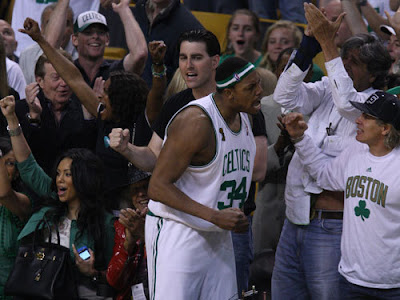
...and plays MVP caliber basketball!

A heroes effort throughout the game!

The injury that caused Celtic fans' hearts to seize:

The warrior returns...

...and plays MVP caliber basketball!

Wednesday, June 04, 2008
What a cute future first couple!
How do you celebrate being the nominee of your Party? Bump bump the fists!

And the slow motion instant reply, reverse angle!

I am a happy Democrat today! Proud of my Party, proud of my country!

And the slow motion instant reply, reverse angle!

I am a happy Democrat today! Proud of my Party, proud of my country!
Thursday, May 15, 2008
Wow, sometimes the press pays attention...
It seems to me that this guy (President Bush) will literally say anything to cover his ass. I am glad that there are people like Keith Olbermann that don't let him get away with it.
I watched this interview yesterday and I have to say that the thing that struck me most about it was exactly how inarticulate the President is. He really struggles to communicate what he is thinking. His relationship with words is almost as staggering as his relationship with the truth. This is what you get, people, when you want a President of average intelligence.
Monday, May 12, 2008
Tuesday, May 06, 2008
Thursday, May 01, 2008
How can you not like these people?
"Ain't nothin' gonna break-a my stride, ain't nothin' gonna slow me down! Oh no, I got to keep on moving."
Wednesday, April 30, 2008
Does this still qualify as "news"?
Here is the scoreboard for the nomination contest:
Delegate Count:
Barack Obama
Total Delegates: 1732
Pledged Delegates: 1489
Super Delegates: 243
Hillary Clinton
Total Delegates: 1595
Pledged Delegates: 1333
Super Delegates: 262
This includes the
But let’s put this aside because the
Popular Vote Total:
Obama: 14,418,784
Margin: Obama +501,466
So, how does Hillary Clinton come to the conclusion that she is leading in the popular vote. Perhaps we should look at the primary states that were stripped of their Delegates by the DNC:
Florida Vote Count:
Obama: 576,214
So, how does that impact the popular vote totals?
Obama: 14,994,998
Margin: Obama +206,694
That does not get her into the lead. What if we add the Michigan Vote Count:
Uncommitted: 238,168
This makes things complicated since there was an agreement among the candidates to not campaign in
Obama: 15,233,166
Margin: Obama +16,553
Of course the problem with these numbers is they don’t count states that hold Caucuses instead of Primaries. Real Clear Politics estimates for what the vote count would be if we included caucus states:
Obama: 4,752,868
Margin: Obama +611,688
Chuck Todd from MSNBC, on Countdown with Keith Olbermann on Wednesday, April 23rd said: “if we treated this the way we would call an election in a state, you know, the way our numbers gurus are looking at this stuff, we would call it. It‘s over. The pledged delegate count is going to be Obama‘s, it just is - because of proportionality, it is mathematically impossible for her to take the lead.”
I try not to argue with Chuck Todd more then absolutely necessary.
Microeconomics 101 for weenie Senators!!!
"Half a tank of gas, that’s his big solution."
- Senator Obama in response to the McCain/Clinton gas tax holiday scheme which analysts say will save the average consumer $30.
I am a bit disappointed to hear Senator Clinton repeatedly pandering to lower income Americans by calling for a suspension of the federal gas tax (a holiday, will there be balloons?) between Memorial Day and Labor Day. I expect that kind of mindless pandering from Senator McCain since it is abundantly obvious that the fundamentals of Microeconomics are so far over his head. But I expected better from the self-anointed master of the issues. Senator Clinton’s entire rationale for running is that she has a better command of the fundamentals of sound public policy than either Senator Obama or Senator McCain, but she is looking pretty average right now.
The best way to explain the impact of a gas tax holiday in Microeconomic terms is: in a market where there is a fixed supply of oil with which to refine petroleum (gas) and a fixed capacity to refine oil (regardless of what lame duck says), the price that consumers pay at the pump will adjust until the demand at that price matches that fixed supply. That is what is referred to as Equilibrium. I filled up my car two days ago and the price was $3.77 per gallon of high grade gasoline.

P = Price, Q = Quantity, S = Supply, D = Demand, P0 = Equilibrium Price, Q0 = Equilibrium Quantity
Many economists are predicting gas prices in the range of $4.00 per gallon by the summer of 2008. That price could (and probably will) include the 18.4¢ per gallon federal gas tax. Whether Congress votes for the gas tax holiday or not is of no significance. Either way, the price will not change. Oh, the price of gasoline will go down by 18.4¢ per gallon but that price will correspond with an increase in demand to bring the market back into Equilibrium. In essence, what Senator McCain and Senator Clinton are pushing for is a shift of that 18.4¢ per gallon from the federal coffers directly into the oil companies' profit statements. Make not mistake, McCain and Clinton are supporting reducing the federal budget and the governments ability to pay for the maintenance of our transportation infrastructure.
This predictable Demand shift can only be prevented by a corresponding increase in short-term Supply. I say short-term supply because oil is a natural resource with a fixed supply. Suppliers and producers can increase output, but only in the short-term. When it's gone, folks, it's gone. It just so happens that the world petroleum market is an oligopoly, that is to say, a market that is served by a finite number of suppliers. They have formed a cartel called the Organization of Petroleum Exporting Countries (OPEC). OPEC has thus far been unwilling to adjust their output levels at the whim of American politicians. Their interest is in maintaining supply levels at their current level because there is no interest to them to do otherwise. There are other market forces and uncertainties that are driving the price of gasoline up. Why would they increase supply and reduce the price of oil? That ain’t capitalist folks, and our entire foreign policy has been predicated on the goal of convincing the world of the genius of the American system, which is at its heart a “free market” system.
The only way to control gas prices and ensure lower prices is to cap the wholesale price of gasoline. I’ll bet a month’s salary that neither McCain nor Clinton have the stomach for that.
If we reduce the taxation level of gasoline the price will drop temporarily (very temporarily) until demand increases to bring the price back to the equilibrium level. Barring a drastic change in the market trends the price of gas (even with a tax holiday) will be higher at Labor Day than it is at Memorial Day. Congress has the power to suspend the gas tax, but not suspend the laws of supply and demand.
It turns out that the candidate with the best grip on reality in this case is Senator Barack Obama. Who woulda thunk it?
Let’s not forget that environmental advocates see a reduction in the gas tax as totally inconsistent with either Senator McCain or Senator Clinton's campaign rhetoric about reducing carbon emissions. The increase in demand that results from the gas tax holiday will increase carbon tailpipe emissions. No way to sugar coat that fact.
Let us also not forget that the federal gas tax is not indexed to the Consumer Price Index and has not been increased since 1995. I will let the following graph depicting the purchasing power of the federal gas tax.

Pretty weak stand Mrs. Clinton. I would have expected better from you than just naked pandering. Do you really think the American people are that dumb? Doesn’t that make you an elitest?
Tuesday, April 22, 2008
Friday, April 18, 2008
Thursday, April 17, 2008
Tuesday, April 15, 2008
Bitter people!
By now the quote is famous. You’ve heard it, Barack Obama at a fundraiser in San Francisco saying:
“You go into some of these small towns in Pennsylvania, and like a lot of small towns in the Midwest, the jobs have been gone now for 25 years, and nothing's replaced them. And they fell through the Clinton administration, and the Bush administration, and each successive administration has said that somehow these communities are gonna regenerate, and they have not. And it's not surprising then they get bitter, they cling to guns or religion or antipathy to people who aren't like them or anti-immigrant sentiment or anti-trade sentiment as a way to explain their frustrations.”
Was it a polite thing to say? No, probably not. Was it politically astute? Nope, surely not. It is usually inappropriate to use broad generalizations when describing group of people or regions of the country. I live in Austin, Texas and please don’t paint me with the same brush as all my neighbors. They are good people but we are pretty diverse.
Here is a hard truth. People who have lost as much as some people in these rural communities have tend to become more traditional. In most cases this probably isn’t a conscious decision (i.e. they don’t know why they are sticking to traditional culture and values). It is called being reactionary. It is neither surprising nor an unreasonable response. Wouldn’t you get “bitter” and xenophobic if a bunch of politicians told you that Mexicans were to blame for all your troubles instead of the politicians that created tax loop-holes for outsourcing manufacturing jobs? I am a realist. Those jobs are leaving anyways. There is nothing to be done about that. But do we need to reward the companies for doing it?
Here is another hard truth: just like the working class people in Pennsylvania see San Franciscans as a total foreign enigma, the opposite is true as well. These are two different worlds and neither of them are one dimensional. But just like Pennsylvanians don’t like to be called gun toting, religious, xenophobic yokels, people in San Francisco are not all rich, liberal, intellectuals who shop at boutique super markets (though the ones I know are). There are Harvard alumni in the steel towns and there are uneducated folks in the Bay Area.
But let’s say, hypothetically, that all San Franciscans are rich, liberal intellectuals. What is wrong with that? I thought that the premise of this country that Republicans liked best was the right to life, liberty and the pursuit of happiness (which they always substitute with pursuit of wealth even though the Founders purposefully chose not to use the phrase ‘and property’, they must have done that for a reason). Is it not the goal of this country to provide opportunity for upward mobility? It isn’t San Francisco’s fault that there is a correlation between educational attainment, wealth and liberal political attitudes. It is called being panoptic versus myopic.
But I digress. In a media world where brevity is rewarded is it any surprise that people have trouble communicating broad issues in a format that sound bytes? It is no shock that there will be instances of misunderstanding. It is easier when you speak in platitudes and emotionalisms like Republicans (e.g. tax cuts good, criminals bad!).
All that aside, I am voting for Barack Obama, because I too like arugula and other organic veggies from Whole Foods! If that offends people in the Heartland – go shoot at some beer cans!
Sunday, April 13, 2008
Thursday, April 10, 2008
Easy does it Honky Cat!
"'I've always been a Hillary supporter,' [Elton] John, 61, said before launching into his 1970 breakthrough hits, 'Your Song' and 'Border Song.' "There is no one more qualified to lead America.
"'The English singer, composer and pianist added: 'I'm amazed by the misogynistic attitudes of some of the people in this country. And I say to hell with them .... I love you Hillary, I'll be there for you.'"
Let me tell you, nothing that heartland voters love more than being lectured by foreigners about our shortcomings! That is definitely going to turn us around!
Monday, April 07, 2008
Subscribe to:
Posts (Atom)